How to Adapt Growing in God’s Word

Churches
Grade Levels
Churches can use the curriculum for elementary-age students during Sunday or midweek services. With 52 lessons, one lesson can be covered each week for a full year. For churches needing K–5th grade curriculum, Level 1 can be used for K–1st grade, Level 2 for 2nd–3rd grade, and Level 3 for 4th–5th grade. Alternatively, for churches needing 1st–6th grade curriculum, Level 1 can be used for 1st–2nd grade, Level 2 for 3rd–4th grade, and Level 3 for 5th–6th grade.
Alternative Schedules
If your church offers both midweek and Sunday classes, you can adapt the material while keeping it within its yearly structure by dividing each lesson between the two classes. For example, focus on the opening prayer, key verse, opening activity, and optional catechism midweek; then cover the Bible teaching and closing activities on Sunday. You could also make time for extra review of the key verse and catechism in the Sunday class while having ample time to do the supplemental closing activities. If your church follows the school calendar and breaks from Christian education during the summer, the curriculum can easily be adjusted to the 36-week schedule outlined on the next page for Christian schools and homeschool families.
Families
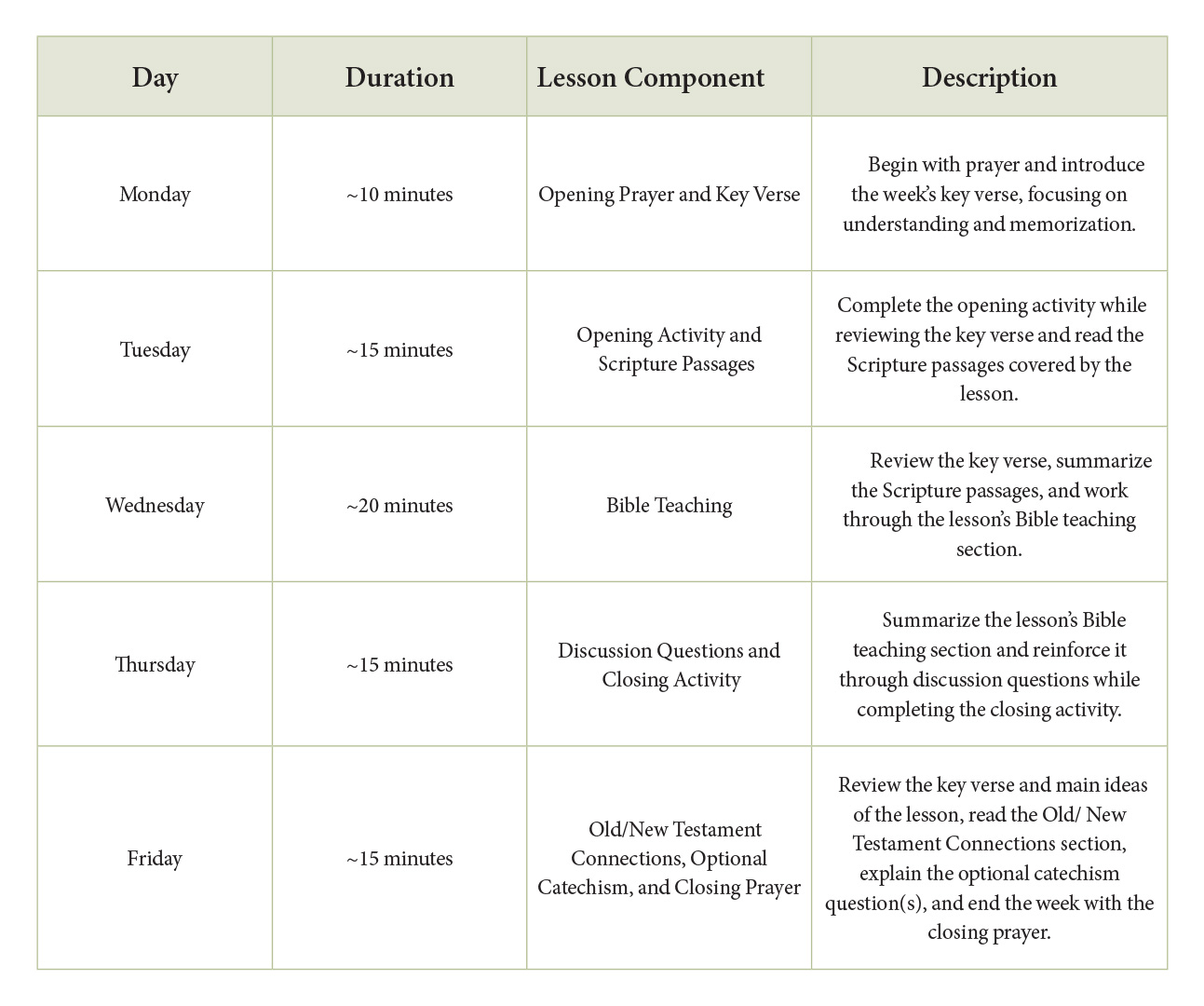
Families can adapt the curriculum for family worship by selecting the lesson components that will best serve their children. This may include doing opening or closing activities with young children, practicing the key verse and memorizing as a family, or walking through the Bible lesson together. For a simplified approach, read the key verse and Scripture passages covered in the Bible teaching as the foundation for your family worship. The teacher’s guide can then be read aloud or paraphrased to help explain the meaning of the passage. You can also promote a sense of involvement and hold the attention of your children by including them in Scripture reading and prayer as they are able.
Christian Schools and Homeschool
Christian schools and homeschool families can adapt the curriculum for classroom use. With the flexible nature of the lesson components, schools can choose the sections they want to include or exclude (including activities, key verse, etc.) based on the length of their class periods. Below, explore several ideas on how to structure the lessons for the year, assuming a 36-week school year with 18 weeks per semester.
Option 1:
Teach 2 lessons per week during the fall semester (36 total lessons) and 1 lesson per week during the spring semester (16 lessons). There will be 2 remaining weeks in the spring, during which schools can supplement with outside material or use to cover school holidays, trips, or breaks. This same format can be flipped to teach 1 lesson per week during the fall and 2 lessons per week during the spring.
Option 2:
Cover only the 26 Old Testament lessons during the school year, teaching 1 lesson per week. This will leave 10 remaining weeks, during which schools can supplement with outside material or use to cover school holidays, trips, or breaks. This same format can be used to cover only the 26 New Testament lessons during the school year.
Option 3:
Cover 3 lessons per week, finishing all 52 lessons in one semester. There will be 2 extra class periods after all the lessons are covered, which can be used for mid-semester and end-of-semester tests or for other purposes.